Core drilling is a high-torque operation that introduces a penetration through a structural or envelope element. Getting it wrong does not just mean a badly positioned hole — it can mean cutting through electrical cables, compromising structural load paths, or creating a dust exposure event that puts you or your client in breach of COSHH regulations.
This guide covers the safety requirements specific to UK diamond core drilling — PPE, pre-drilling checks, machine anchoring, dust control, and the CDM regulations that apply to notifiable work. For a broader assessment of whether diamond core drilling is safe compared to percussion methods, see: is diamond core drilling safe?
Safety at a Glance
- Sweep for cables and pipes before every drilling job — use a cable and pipe detector
- Minimum FFP3 respirator plus dust extraction for any core drilling in concrete or masonry
- Use RCD protection on all electrical supplies near drilling operations
- For 107mm and above in hard material: use a side handle and consider a machine stand
- COSHH requires engineering controls (extraction) before relying on respiratory protection
What Checks Should I Do Before Core Drilling?
Run a cable and pipe scan, a structural check, and a service location survey before drilling any penetration. These steps are mandatory on commercial sites and strongly advised on all jobs:
Electrical Survey
In the UK, electrical cables in domestic buildings are required to run vertically and horizontally from socket and switch positions (the zones defined in BS 7671 / Part P). However, this only applies to work carried out since approximately 1992. Older wiring, extension wiring, and DIY wiring does not follow these rules reliably. Before drilling any wall penetration, sweep the zone with a cable and pipe detector (Zircon, Bosch GMS, or equivalent). Sweep both horizontally and vertically, and scan at least 300mm either side of the intended drill position. For electricians drilling cable entries specifically, see: core drilling for electricians: sizes and safety requirements.
Structural Assessment
Core drilling removes material from the wall cross-section. In a standard 100mm block inner leaf, a 107mm core removes essentially the full width of the block at that course — which is why in load-bearing walls, core penetrations should be in the upper third of the wall height where stress concentrations are lower, and should not be clustered within 500mm of each other. For structural concrete or steelwork, a structural engineer should be consulted before drilling any penetration greater than 50mm. If the wall or slab is reinforced, see the reinforced concrete drilling guide.
Service Locations
Gas pipes, water pipes, and buried communication cables do not follow defined zones in the way electrical cables are supposed to. Use a combined detection device — cable detector plus GPR or acoustic detection for larger sites. On domestic retrofits, check service entry points and follow pipes visually before drilling near them.
Personal Protective Equipment
Eye Protection
Non-negotiable. Core drilling in masonry or concrete creates high-velocity fragments. Polycarbonate safety glasses to EN166:1 (F-rated for intermediate energy impact) are the minimum. For overhead drilling or wet coring, a full wraparound shield is preferable.
Respiratory Protection
This is where most domestic tradespeople are dangerously under-protected. Drilling through concrete, brick, or block produces respirable crystalline silica (RCS) dust. RCS causes silicosis — an irreversible, progressive lung disease with no cure. The Control of Substances Hazardous to Health (COSHH) regulations require employers to assess and control RCS exposure. On commercial sites, the Workplace Exposure Limit (WEL) for RCS is 0.1 mg/m³ over an eight-hour period.
An FFP2 or FFP3 dust mask is the minimum for any coring in masonry or concrete. FFP3 (P3 class) is required for any extended coring operation or work in an enclosed space. A dust shroud and extraction system — covered in the dust extraction guide — controls the source. Do not rely solely on a mask if extraction can be fitted.
Hearing Protection
A dedicated core drill motor produces noise levels of 85–95 dB(A). The Control of Noise at Work Regulations 2005 require hearing protection above 80 dB(A) exposure action value and mandatory protection above 85 dB(A). Ear plugs (SNR 20+) or ear defenders for any core drilling session lasting more than a few minutes.
Gloves
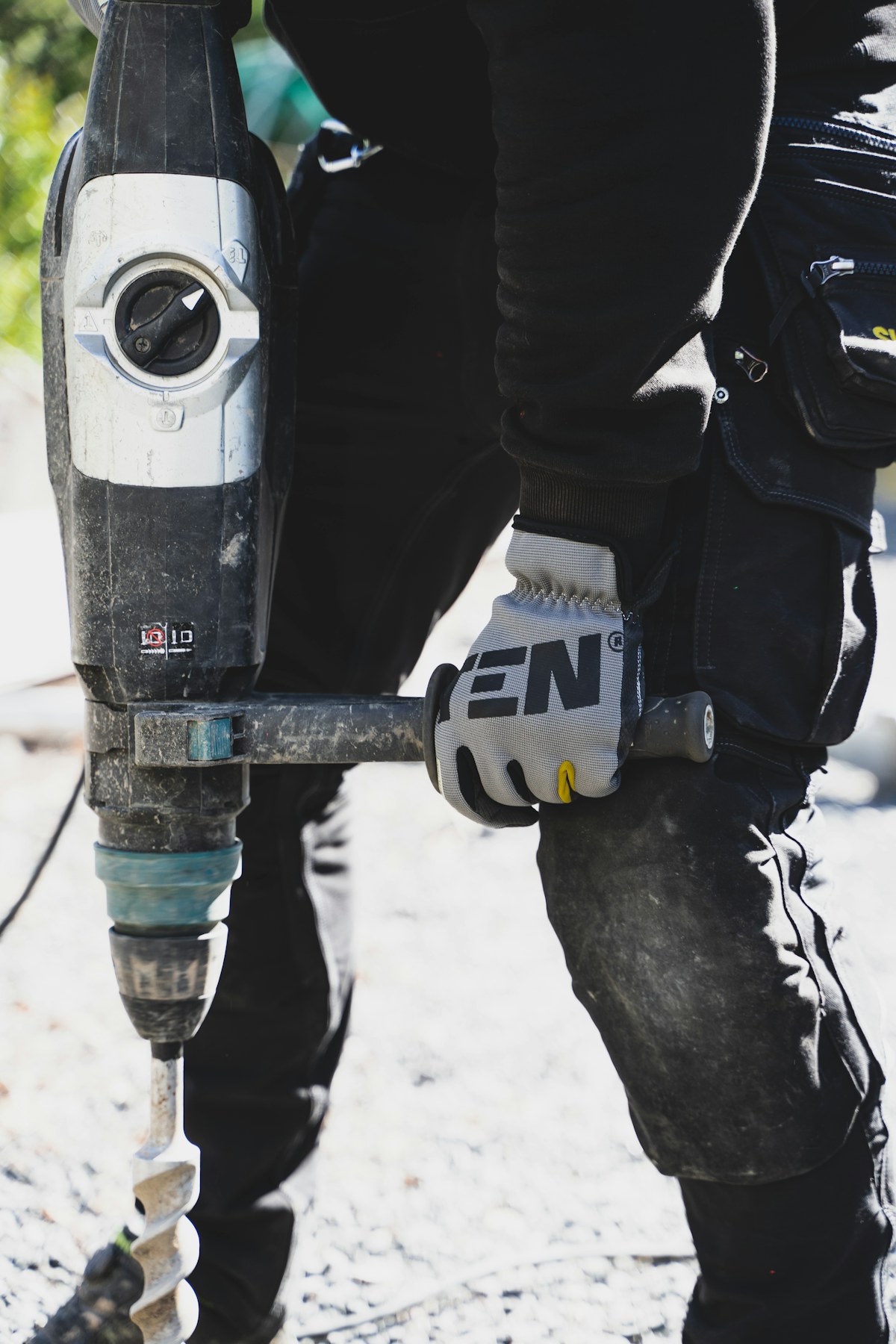
Anti-vibration gloves reduce the risk of hand-arm vibration syndrome (HAVS), which is a recognised occupational disease under the Control of Vibration at Work Regulations 2005. Core drilling machines have relatively low vibration compared to breakers and hammer drills, but prolonged use without gloves is inadvisable. Use cut-resistant, anti-vibration gloves — not thin disposable nitrile gloves, which provide no vibration protection. See: Low-vibration drilling methods and HAVS control.
When Do I Need to Anchor a Core Drill to the Wall?
Anchor or brace the machine for any core drilling at 107mm and above in hard material. Core drilling at 107mm and above in hard material creates significant torque reaction. If the bit binds — which happens when drilling into rebar, hitting a hard inclusion, or when the core slug jams — the torque is transferred directly to your hands and wrists. At 125mm and above in dense material, this torque is sufficient to cause serious wrist and shoulder injury.
For any coring at 107mm or above in hard material, use a machine with a side handle and brace against a fixed structure. For 150mm and above, a stand-mounted core drill motor is the safe approach — see the core drill machine guide for stand-compatible motors. Many professional-grade machines include a torque clutch that releases before injury-level torque is reached — check the machine specification before ordering.
Wet Coring Additional Hazards
Wet diamond core drilling introduces electrical and slip hazards that dry coring does not:
- Water near electricity: Ensure the work area is protected from water spray. Use RCD protection on any electrical supply used near wet coring operations. All IEC 60745-rated core drill machines include RCD integration, but site supply RCDs are an additional layer of protection.
- Slurry disposal: Concrete and masonry slurry is highly alkaline (pH 12–13) and classified as a controlled waste. It cannot be discharged to surface drains or waterways. Collect with a slurry vacuum or absorbent mat and dispose as construction waste.
- Overhead drilling: Wet slurry running down the barrel onto the operator is a skin irritant. Wear arm protection and use a collection ring around the barrel when drilling overhead.
CDM Regulations — When Do They Apply?
The Construction (Design and Management) Regulations 2015 apply to all construction work in the UK. For most domestic core drilling operations, CDM is relevant in the sense that:
- A notifiable project (longer than 30 working days with more than 20 workers simultaneously, or exceeds 500 person-days) requires appointment of a Principal Designer and Principal Contractor and notification to the HSE.
- All projects must have a construction phase health and safety plan — even single-trade domestic jobs on paper, though in practice the enforcement focus is on larger projects.
- COSHH assessments for silica dust exposure are required whenever drilling in silica-containing materials (virtually all masonry and concrete).
For sole-trader domestic plumbers, electricians, and builders, the practical application is: do a dust risk assessment, use adequate extraction and PPE, and keep a record of it. The HSE has freely available Construction Dust guidance specific to core drilling, including silica dust control requirements and COSHH compliance. Professional drilling contractors operating to the standards of the Drilling and Sawing Association (DSA) are required to maintain current COSHH risk assessments and PPE records for all site operations. For the full regulatory framework covering COSHH, CDM 2015, GPR scanning requirements, and PPE standards: health and safety in diamond core drilling.
Lone Working
Core drilling is often a solo operation on domestic jobs. If the bit binds and the machine kicks, a lone worker has no one to assist. Always inform someone of your location and expected duration before starting a solo coring job. Keep a mobile phone accessible but not in a pocket where it could be reached for during a machine kick. For any job involving structural penetrations or overhead coring, a second person in the immediate vicinity is strongly recommended.