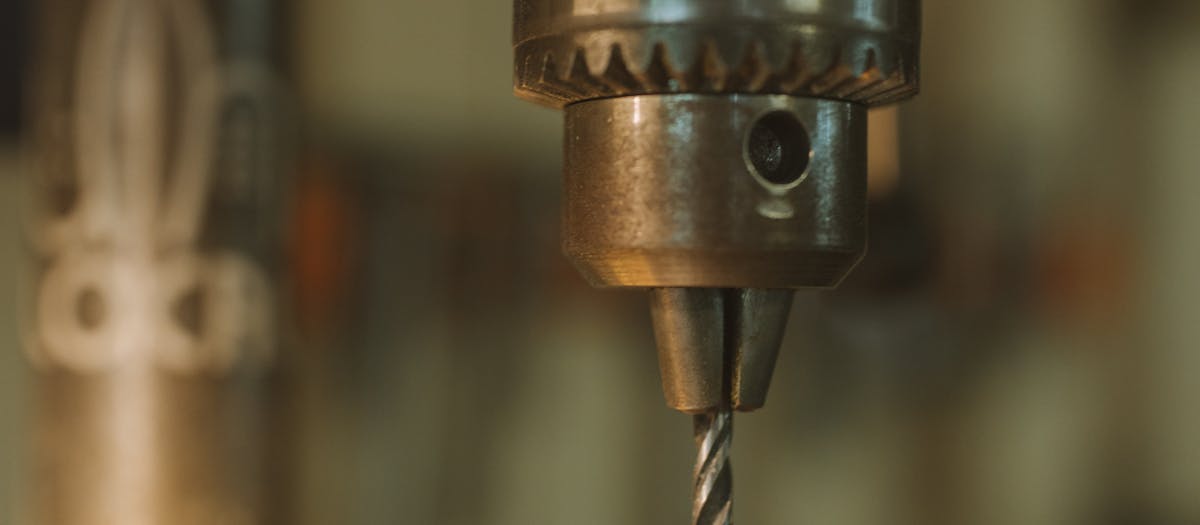
Diamond core drilling works on a fundamentally different principle from percussion drilling. Understanding the mechanics — how diamond particles remove material, why bond hardness matters, and what water actually does — explains the practical rules around RPM, material selection, and bit specification that experienced drillers follow by instinct.
Core Drilling Mechanics at a Glance
- Diamond crystals cut by abrasion — harder than any building material, they scratch and fracture the substrate as the bit rotates
- Bond matrix controls how quickly diamond is exposed — soft bond for hard materials (concrete); hard bond for soft materials (brick, block)
- Water cools the segments — it does not lubricate the cut; without it, heat destroys the diamond-bond interface
- Peripheral speed (not RPM) is the critical speed variable — larger bits need lower RPM to maintain the same cutting surface speed
- Rotation-only, no percussion — impact fractures diamond crystals and destroys the segment attachment
How Does Diamond Abrasion Work?
Diamond is the hardest naturally occurring material on the Mohs scale (10/10). Every building material a core drill encounters — concrete, brick, block, stone — is softer. When diamond crystals are exposed at a rotating cutting face and pressed against a substrate, they scratch and fracture the material progressively as the bit turns. This is abrasion, not cutting in the conventional sense.
Each diamond crystal removes a tiny amount of material per rotation. At 300–500 RPM, the cutting face of a 107mm bit completes thousands of revolutions per minute, with each revolution contributing a fraction of a millimetre of depth. The accumulation of these micro-abrasions advances the core through the material at a steady rate.
Unlike a saw blade or a lathe, the diamond core bit does not have a sharp edge that becomes blunt. Instead, worn diamond crystals are shed from the bond matrix, exposing fresh crystals beneath. The cutting face regenerates continuously as long as the bond releases correctly for the material being drilled. This is why correct bond hardness specification matters more than bit brand or price.
What Is the Bond Matrix and Why Does It Matter?
Diamond crystals in a core bit segment are embedded in a bond matrix — a metal or metal-resin composite that holds them in place. The hardness of this matrix determines how quickly the bond wears away and how frequently fresh diamond is exposed. The key rule: harder drilling materials require a softer bond; softer materials require a harder bond.
- Soft bond — the matrix wears away quickly under abrasion. Fresh diamond is exposed rapidly. Correct for hard, dense materials (structural concrete, engineering brick, granite) where the substrate itself wears the bond efficiently. In soft material, a soft bond wears too fast — the bit is consumed before its cutting capacity is used.
- Medium bond — intermediate wear rate. Suitable for standard construction concrete (C25–C35), medium-hardness masonry, and mixed-substrate applications.
- Hard bond — the matrix resists wear. Diamond exposure is slow and sustained. Correct for soft, non-abrasive materials (standard facing brick, aerated concrete, limestone) where the substrate does not naturally shed the bond fast enough. In hard material, a hard bond fails to expose fresh diamond and the bit glazes.
Glazing is the diagnostic term for a diamond core bit whose segments appear smooth and shiny rather than textured with exposed crystal points. A glazed bit has stopped cutting because worn diamond is not being shed and fresh diamond is not being exposed. The fix is to redress the bit — make several passes through a soft abrasive material (aerated block, sand-lime brick) to shed the glazed surface layer and re-expose diamond. See: diamond core drill bit maintenance.
Why Water Is Used — and What It Actually Does
Water in wet diamond coring is a coolant, not a lubricant. The distinction matters:
At the cutting face, diamond abrasion against concrete or stone generates significant heat. The segment-to-substrate interface reaches temperatures that, without cooling, would soften the bond matrix around the diamond crystals and allow them to release prematurely — not through normal bond wear, but through thermal delamination. Segment loss is the result: the segment detaches from the barrel mid-cut, destroying the bit and potentially causing a safety event.
Water delivered through the centre of the core barrel reaches the cutting face continuously, absorbing and carrying away this heat. The required flow rate is approximately 0.5–1.5 litres per minute for standard structural concrete work. The water also carries away the swarf — the fine particles of ground material — keeping the cutting face clear and preventing slurry from binding inside the barrel.
A secondary function of wet coring is silica dust suppression at source. Wet cutting converts potential airborne silica into wet slurry, which settles rather than becoming respirable. This is why wet coring significantly reduces silica dust exposure compared to dry methods, though COSHH controls are still required. See: dust extraction for core drilling.
Peripheral Speed and Why Larger Bits Need Lower RPM
The variable that determines how fast the diamond crystals are moving against the substrate is not RPM — it is peripheral speed: the speed at which the outer edge of the bit travels. Peripheral speed is calculated as:
Peripheral speed (m/min) = π × bit diameter (m) × RPM
For a given material, there is an optimal peripheral speed range — fast enough for the diamonds to abrade efficiently, slow enough to avoid excessive heat and premature crystal loss. Because larger bits have a greater circumference, they reach the same peripheral speed at a lower RPM than smaller bits.
As a practical example: a 38mm bit running at 900 RPM has a peripheral speed of approximately 107 m/min. A 107mm bit running at the same 900 RPM would have a peripheral speed of approximately 302 m/min — three times faster, far above the optimal range for most masonry. The 107mm bit should run at approximately 300–500 RPM to stay in the correct peripheral speed band. This is why the RPM tables used by UK trade professionals are not arbitrary — they are derived from peripheral speed targets for each bit diameter. See: core drill speed and RPM guide.
How Does the Core Slug Form?
Diamond core drilling removes material in an annular ring — the bit cuts around the circumference of the intended hole, leaving a solid cylindrical plug (the core slug) intact inside the barrel. As the bit advances, the slug grows in length within the barrel until the bit has penetrated the full depth of the wall or slab. The slug is then removed — by tapping the barrel against a hard surface or pushing it out through the centre hole — and the hole is left clean on both faces.
The slug remains intact when:
- Feed pressure is applied evenly without lateral movement
- The bit does not bind or deflect mid-cut
- Exit feed pressure is reduced as the bit approaches breakthrough
Slugs fragment when percussion is applied (hammer mode destroys the slug and damages the cutting face), when the bit deflects due to incorrect alignment, or when the material is highly friable (aerated concrete or very soft stone). A fragmented slug jams inside the barrel and requires removal before drilling can continue.
Why Core Drilling Uses Rotation Only — No Hammer
Diamond core drilling must run in rotation-only mode — percussion (hammer) mode destroys the bit. This is a hard requirement, not a preference.
Diamond crystals are extremely hard but also brittle. A percussion hammer blow fractures the exposed crystal points that are responsible for abrasion. After even a few hammer blows, the cutting face is populated with fractured crystals that no longer abrade efficiently. The mechanical shock also stresses the bond-to-segment and segment-to-barrel welds, accelerating delamination.
Percussion also breaks the core slug — the cylindrical plug of intact material inside the barrel — causing fragments to jam the barrel and preventing further advance without clearing.
The result is that a diamond core bit used in hammer mode will be destroyed in minutes. The machine may appear to be working (it is advancing), but the bit is being consumed, not cutting.
For the full guide to bit selection, bond hardness, and UK sizes: diamond core drill bits guide. For machine specifications and speed ranges: best core drilling methods UK.
Core Drilling Mechanics: Common Questions
Why does a diamond core drill need to run on rotation only with no hammer?
Diamond crystals are hard but brittle. Percussion impact fractures the exposed crystal points that do the cutting — after a few hammer blows, the segment face is populated with fractured crystals that can no longer abrade the substrate. Percussion also fractures the core slug inside the barrel, causing jamming. A diamond core bit used in hammer mode is destroyed within minutes. The hammer function must be disabled before fitting a diamond core bit.
Why does a larger core bit need a lower RPM?
Because the variable that matters is peripheral speed — how fast the cutting edge moves against the substrate — not RPM directly. Peripheral speed = π × diameter × RPM. A larger bit has a greater circumference, so it reaches the same peripheral speed at a lower RPM. Running a 107mm bit at the same RPM as a 38mm bit makes the cutting face move approximately three times faster, generating too much heat and wearing segments prematurely. Correct RPM tables are derived from optimal peripheral speed ranges for each bit diameter and material type.
What is the bond matrix in a diamond core bit?
The bond matrix is the metal or metal-resin composite that holds diamond crystals in place within each segment. Its hardness controls how quickly the bond wears away and exposes fresh diamond at the cutting face. Soft bond suits hard materials (concrete, engineering brick) — the hard substrate wears the matrix efficiently, keeping fresh diamond exposed. Hard bond suits soft materials (standard brick, aerated block) — the soft substrate doesn't wear the bond quickly enough to keep exposing diamond, so a harder matrix maintains the cutting geometry longer.