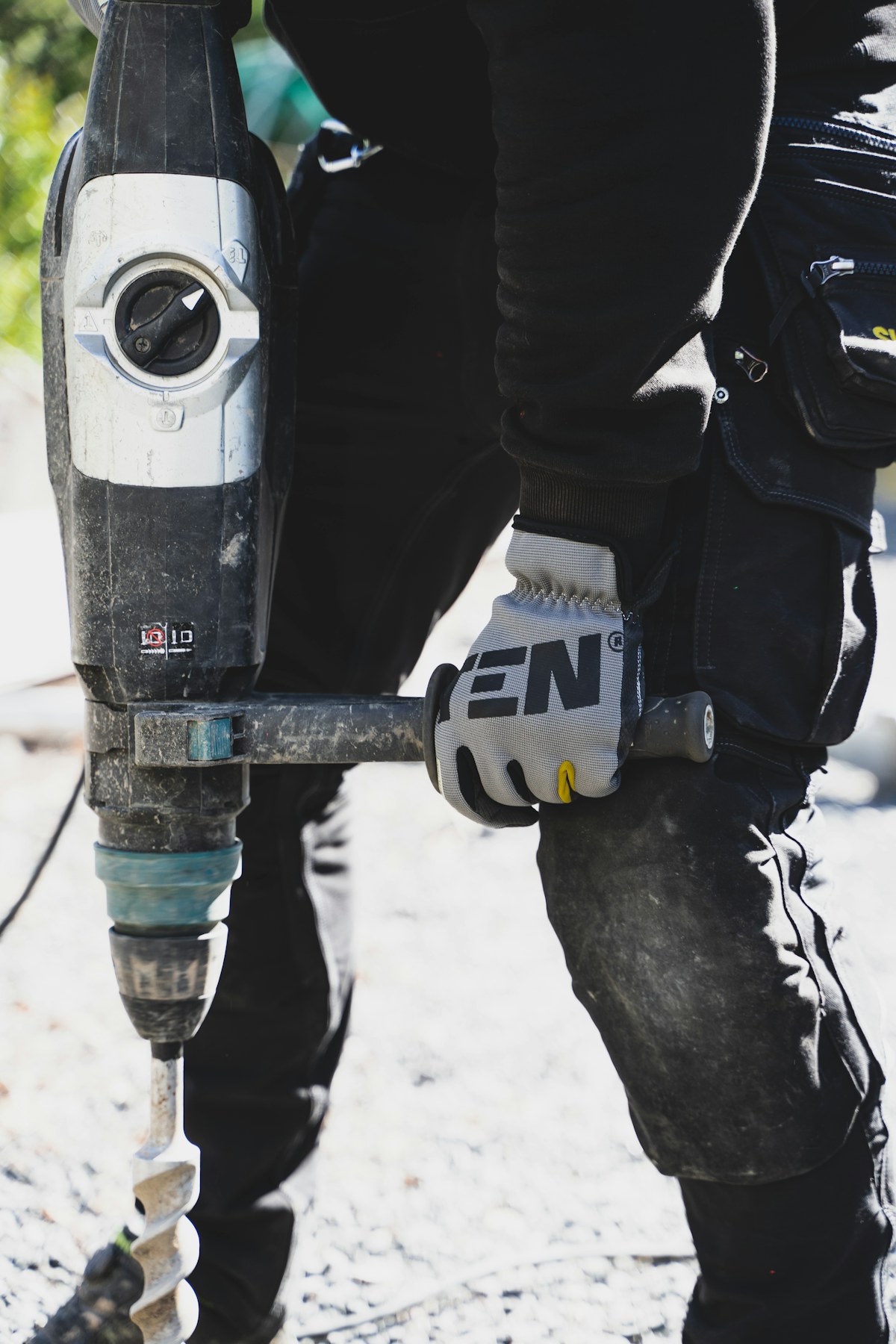
Diamond core drilling on UK construction sites intersects with a well-defined set of health and safety regulations. Two hazards dominate: respirable crystalline silica (RCS) dust generated when cutting concrete, brick, and masonry; and structural risk arising from drilling into reinforced or post-tensioned concrete without pre-drill scanning and engineering approval. Both are foreseeable, both are controllable, and both carry significant legal and practical consequences when controls are absent.
Core Drilling H&S at a Glance
- Silica (RCS): COSHH 2002, WEL 0.1 mg/m³ — M-Class extraction is the HSE-specified minimum control for masonry drilling
- CDM 2015: structural concrete drilling on notifiable projects must be in the pre-construction H&S plan
- Pre-drill scanning: GPR mandatory before drilling any structural concrete where PT cannot be ruled out
- PPE minimum: RPE (FFP3 or half-face P3 respirator), safety glasses, hearing protection, gloves
- Wet drilling suppresses RCS at source — preferred over dry for all concrete work in enclosed spaces
- Overhead drilling: rigid rig or stand required above 52mm — never handheld above this diameter
- Slurry from wet coring: controlled waste — cannot be discharged to surface drains
COSHH 2002 and Respirable Crystalline Silica
The Control of Substances Hazardous to Health Regulations 2002 (COSHH) require employers to assess and control exposure to hazardous substances. Respirable crystalline silica (RCS) — the fine particle fraction of silica dust that penetrates to the alveolar region of the lungs — is classified as a substance hazardous to health under COSHH. Prolonged RCS inhalation causes silicosis (an irreversible and progressive fibrotic lung disease), lung cancer, and chronic obstructive pulmonary disease (COPD).
The HSE has set a Workplace Exposure Limit (WEL) for RCS of 0.1 mg/m³ (8-hour time-weighted average). Tasks that generate RCS concentrations above this limit without controls include drilling concrete, brick, and masonry; cutting and grinding these materials; and dry sweeping of the resulting dust. Without dust suppression or extraction, core drilling through brick generates measured RCS concentrations many times above the WEL within seconds of operation.
Required Controls Under COSHH for Core Drilling
- Wet drilling (for concrete): A continuous water supply to the bit face suppresses RCS at source. This is the most effective single control for concrete drilling — it reduces airborne silica to near-zero at the drilling face compared to dry operation. COSHH requires that wet drilling is used wherever practicable for concrete coring.
- M-Class dust extraction (for masonry, brick, and dry operations): An M-Class vacuum (meeting EN 60335-2-69 with filtration efficiency ≥99% at 0.3 microns) connected to a dust shroud is the HSE-specified minimum control for dry masonry drilling and chasing tasks. The HSE's CIS36 Construction Information Sheet explicitly identifies M-Class vacuum extraction with a shroud as the required control for these operations.
- Respiratory protective equipment (RPE): Where engineering controls cannot reduce exposure below the WEL — or as interim protection while controls are being established — FFP3 disposable respirator or a half-face mask with P3 filter is the minimum standard for silica tasks. Note: RPE is a last-resort control under COSHH hierarchy, not a substitute for extraction.
- Housekeeping: Drill slurry and masonry dust must not be dry swept — sweeping disperses settled dust back into the breathing zone. Use a vacuum or wet mopping to clean down after drilling. Bag and remove dust waste; do not allow it to accumulate on site.
See: core drill dust extraction: M-Class vacuum guide, silica dust control in UK construction, and dry core drilling services.
CDM Regulations 2015
The Construction (Design and Management) Regulations 2015 (CDM 2015) impose specific duties on clients, designers, principal designers, principal contractors, and contractors on construction projects. For diamond core drilling, the key CDM obligations are:
On Notifiable Projects
A project is notifiable to the HSE if it lasts more than 30 working days with more than 20 simultaneous workers, or exceeds 500 person-days. On notifiable projects:
- The Principal Contractor must ensure that structural concrete drilling is addressed in the pre-construction health and safety plan, including scanning protocols, method statements, and COSHH assessments
- The drilling contractor must provide a written method statement and COSHH assessment before work begins
- Pre-drill GPR scanning reports must be retained on site as part of the H&S file
- The drilling contractor's operatives must hold valid CSCS cards
On Non-Notifiable Projects
CDM 2015 still applies to all construction work regardless of project size — only the notification duty and the requirement for a Principal Designer appointment are threshold-dependent. Contractors are still required to manage risks, carry out COSHH assessments, and ensure safe working practices on all jobs including small domestic works.
For the full regulatory breakdown by project type: core drilling permits and regulations: UK guide.
Pre-Drill Scanning and Structural Risk
The structural hazard unique to concrete core drilling is striking a post-tensioned (PT) tendon. Post-tensioned tendons are high-tensile steel cables held under active compressive load within a concrete slab or beam. Cutting or drilling through a PT tendon releases the stored energy violently, can cause immediate localised structural failure, and may trigger progressive collapse of the affected structural zone. Incidents involving PT tendon strikes have caused fatalities on UK construction sites.
When GPR Scanning is Mandatory
- Any structural concrete element where post-tensioning cannot be confirmed absent by structural drawings
- Commercial and industrial buildings constructed from the 1960s onwards — PT flat slabs are common in offices, carparks, and multi-residential buildings from this period
- Industrial warehouse floors — frequently post-tensioned to control cracking across large spans
- Bridge decks and highway concrete — GPR and PAS 128 scanning protocol required
- Any element where structural drawings are unavailable, incomplete, or uncertain
Ferroscan vs GPR
Ferroscan (electromagnetic induction scanning) locates conventional steel reinforcement and measures cover depth accurately. It does not reliably detect post-tensioned grouted tendons. GPR (ground penetrating radar) detects both conventional rebar and PT duct profiles in the concrete section. Where post-tensioning is possible, GPR is the required tool — ferroscan alone is insufficient. Where structural drawings confirm the absence of PT and only rebar mapping is required, ferroscan is a faster and adequate tool.
See: GPR scanning before core drilling: UK guide.
PPE Requirements for Core Drilling
The following PPE is the minimum standard for diamond core drilling tasks on UK construction sites:
| Hazard | PPE Required | Standard |
|---|---|---|
| Respirable silica dust | FFP3 disposable or half-face P3 respirator | EN 149 (FFP3) or EN 140 + P3 filter |
| Noise from drill motor | Hearing protection (30dB+ attenuation) | EN 352 |
| Eye / face hazard (water, debris) | Safety glasses (dry); full face shield (overhead wet drilling) | EN 166 |
| Hand-arm vibration (HAV) | Anti-vibration gloves (supplementary — primary control is rig use and low-vibration machines) | EN ISO 10819 |
| Wet conditions (slurry, water) | Waterproof boots, waterproof coveralls where appropriate | EN 20345 |
| Head protection (where overhead risk) | Safety helmet | EN 397 |
RPE must be face-fit tested for each operative — a respirator that is not correctly fitted provides negligible protection against fine RCS particles. Face fit testing to EN 529 is standard practice for contractors carrying out regular silica-generating tasks. See: diamond core drill safety guide.
Hand-Arm Vibration (HAV)
The Control of Vibration at Work Regulations 2005 sets an exposure action value (EAV) of 2.5 m/s² A(8) and an exposure limit value (ELV) of 5.0 m/s² A(8) for hand-arm vibration. Handheld core drilling generates measurable vibration — the typical vibration emission of a core drill motor is 3–7 m/s², depending on the machine, bit, and material. Using a rig-mounted setup eliminates operator-transmitted vibration almost entirely; handheld operation should be limited in duration, especially in hard or abrasive materials where the machine vibrates more under load.
See: low-vibration drilling methods: UK guide.
Health and Safety: Common Questions
What is the legal dust control requirement for core drilling through concrete?
COSHH 2002 requires that RCS exposure is reduced to as low as reasonably practicable. For concrete core drilling, the HSE hierarchy of controls specifies wet drilling (water supplied to the bit face) as the primary and most effective control — it suppresses silica at source and is the standard for all structural concrete work. Where wet drilling is not practicable, dry drilling with a Class M vacuum and dust shroud is permitted, but this produces higher residual airborne dust and requires more rigorous RPE use. The HSE's WEL for RCS is 0.1 mg/m³ (8-hour TWA).
Does CDM 2015 apply to small domestic drilling jobs?
CDM 2015 applies to all construction work, including domestic projects. The notification threshold (projects lasting more than 30 working days with more than 20 simultaneous workers, or exceeding 500 person-days) determines whether the HSE must be notified and whether a Principal Designer must be appointed — but the duty to manage risks, carry out COSHH assessments, and work safely applies to all projects regardless of size. On a domestic drilling job, the contractor is still required to control RCS exposure, use safe drilling methods, and ensure the work does not create structural risk to the property.
What happens if a post-tensioned tendon is struck during core drilling?
Striking a post-tensioned tendon during core drilling can cause immediate catastrophic localised structural failure at the point of the strike, with the potential for progressive collapse of the affected structural zone. PT tendons are under active compressive load — cutting the tendon releases the stored energy suddenly. On UK construction sites, PT tendon strikes have caused fatalities and serious structural damage. This is why GPR scanning by a specialist before any structural concrete drilling is not optional — it is a safety-critical step that must be completed before drilling commences wherever PT cannot be ruled out.