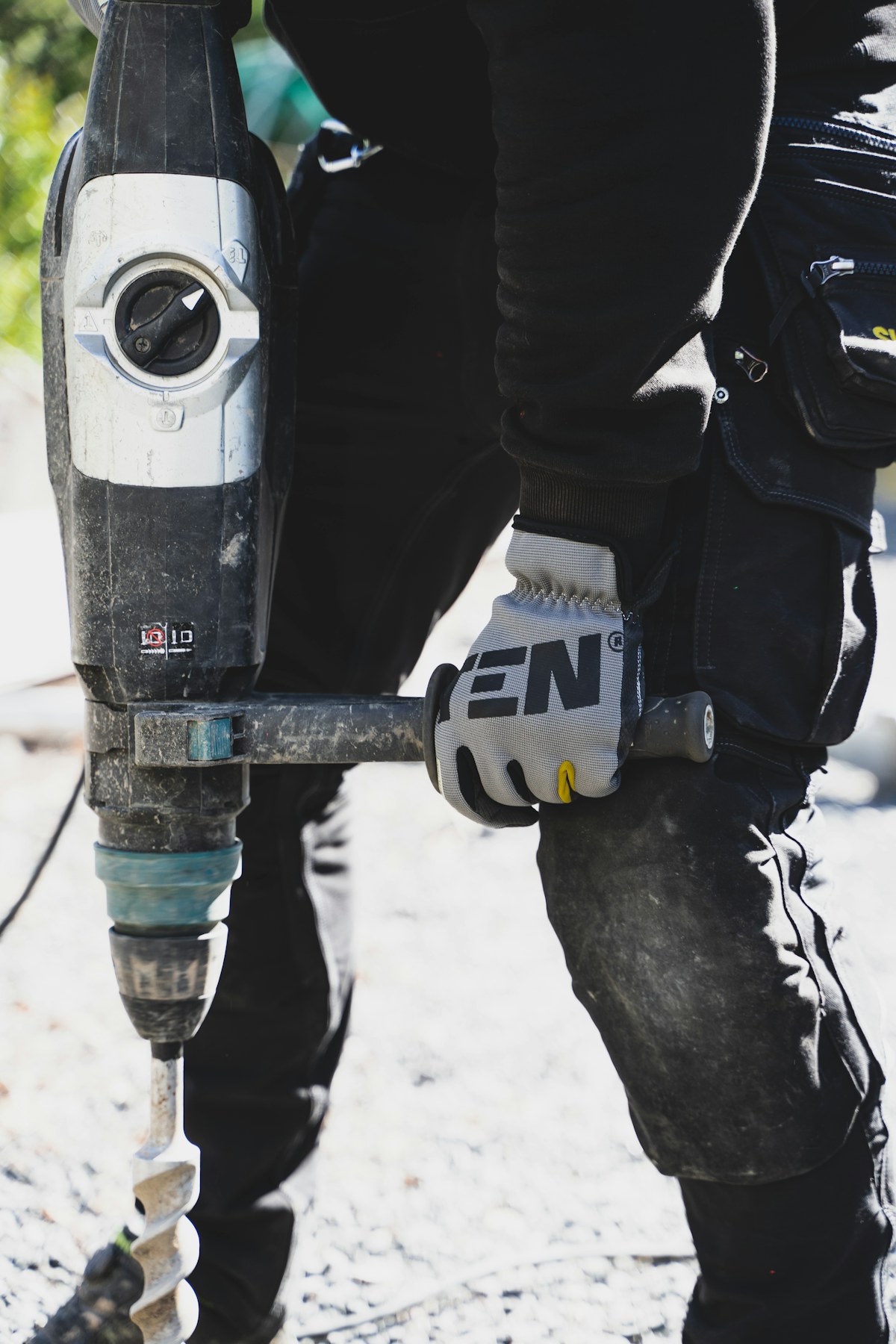
Dry core drilling is the standard method for creating circular penetrations through brick, blockwork, and soft masonry in UK domestic and light commercial construction. No water supply is needed — the bit uses a slotted or turbo barrel to air-cool the diamond segments and eject debris without liquid. When paired with an M-Class dust extraction vacuum, dry coring is a clean, efficient, and COSHH-compliant method for the most common trade drilling applications: boiler flues, soil stacks, waste pipes, cable entries, and extractor fan holes.
Dry Core Drilling at a Glance
- Correct for: brick, blockwork, sand-lime brick, aerated concrete (Thermalite, Celcon), soft masonry
- Not for: concrete, reinforced concrete, hard engineering brick, natural stone (use wet core drilling)
- No water supply required — air cooling through turbo or slotted barrel
- M-Class vacuum dust extraction required under COSHH for silica-generating tasks
- Hard-bond bit: standard for soft to medium brick and blockwork
- Universal bit: correct where substrate is unknown or mixed brick and block
- RPM: 300–600 for 107mm; reduce proportionally for larger diameters
- Common trade sizes: 38mm (cable) to 117mm (soil stack) in a single pass
When Dry Core Drilling Is Correct
Dry diamond core drilling is the right method for soft to medium-hardness masonry that does not generate sufficient heat to damage air-cooled segments. Correct applications include:
- Standard sand-lime brick: The most common UK domestic external wall material. Dry coring at 300–500 RPM with a hard-bond bit cuts cleanly through both leaves of a cavity wall.
- Dense aggregate block: Inner leaf blockwork in cavity walls. Hard-bond dry bit, same RPM range as brick.
- Lightweight aerated concrete block (Aircrete — Thermalite, Celcon, Durox): Very low compressive strength (2.5–7.5 MPa). A dry bit at reduced feed pressure and 400–600 RPM. Aircrete cuts quickly — do not force the feed.
- Rendered and plastered surfaces: Render coats and plaster layers do not require specification change; the underlying brick or block substrate determines the bit.
- Cellular concrete and lightweight partition block: Where used as non-structural partitions, lightweight cellular concrete suits a dry bit at low feed pressure.
When Dry Core Drilling Is Not Suitable
Dry core bits must not be used on materials that exceed the thermal threshold for air cooling:
- Concrete of any type: Plain concrete, reinforced concrete, and precast concrete all require wet coring. A dry bit on concrete glazes within seconds — the segments overheat, the matrix polishes smooth, and the bit stops cutting. See: wet core drilling services.
- Reinforced concrete: Same restriction as plain concrete, with the additional rebar-rated bit requirement. See: reinforced concrete drilling services.
- Hard engineering brick (blue brick, dense calcium silicate): Engineering brick above 65mm is too hard for standard dry bits. A universal dry/wet bit or a dedicated wet bit is required.
- Natural stone: Limestone, sandstone, granite, and slate are too abrasive and dense for dry coring at practical trade diameters. Wet coring is required.
- Ceramic and porcelain tiles: Tiles require a wet diamond bit, not a dry core bit. Dry bits crack tiles and generate excessive dust. See: core drilling through tiles guide.
How Dry Coring Works
Dry diamond core bits use a turbo or slotted barrel design. The slots allow air to circulate along the cutting face and up the barrel during rotation, carrying heat away from the diamond segments and ejecting loose debris and masonry dust up and out of the hole. This air-cooling effect keeps segment temperatures within safe limits for brick and soft masonry.
The barrel geometry also assists slug ejection — as the core slug forms within the barrel, the segment profile and barrel shape help the slug break free periodically rather than binding. In standard brick, the slug typically drops out at completion or on bit withdrawal.
See: how core drilling works: diamond abrasion and bond matrix explained and dry vs wet core drilling: full guide.
Bit Specification for Dry Coring
| Material | Bit Specification | Notes |
|---|---|---|
| Standard sand-lime brick | Hard bond dry | Most common domestic external wall material |
| Dense aggregate block | Hard bond dry | Inner leaf cavity wall blockwork |
| Aerated concrete block (Aircrete) | Hard bond dry — light feed | Low feed pressure; material cuts quickly |
| Mixed / unknown substrate | Universal (dual-rated) | Covers soft to medium hardness masonry |
| Reclaimed or mixed brick | Universal | Reclaimed brick hardness varies widely |
| Soft natural stone (soft limestone) | Hard bond dry — trial advised | Some soft limestone suits dry coring; confirm with a test core |
For the complete UK bit size and type reference: diamond core drill bit sizes chart and diamond core drill bits guide.
M-Class Dust Extraction
Dry core drilling through brick and masonry generates fine airborne dust containing respirable crystalline silica (RCS). RCS causes silicosis — an irreversible and progressive lung disease — and is regulated under the Control of Substances Hazardous to Health Regulations 2002 (COSHH) as a substance hazardous to health. The HSE's Construction Information Sheet CIS36 specifies M-Class dust extraction as the minimum control measure for dry masonry drilling tasks.
M-Class vacuum extractors meet EN 60335-2-69 with a filtration efficiency of 99% or higher for medium-hazard dust including RCS. In practice, this means:
- The vacuum is connected to a dust shroud fitted around the drill bit or to the drill's built-in dust port
- The shroud must maintain contact with the wall surface during drilling to prevent dust bypass
- The vacuum filter must be checked and emptied regularly — a blocked filter reduces airflow and dust capture effectiveness
- The vacuum bag and filter must be changed using respiratory precautions — silica dust remains hazardous after collection
See: core drill dust extraction: M-Class vacuum guide and silica dust control in construction.
Practical Setup for Dry Coring
Standard setup for a domestic dry core drilling job (107mm boiler flue through a cavity brick wall):
- Mark and centre: Mark the hole centre on the internal wall surface. Fit the pilot drill (SDS or centre bit) to locate the bit and prevent walking.
- Attach dust shroud: Fit the dust shroud to the core bit or drill body. Connect the M-Class vacuum hose. Switch vacuum on before drilling starts.
- Set RPM: 300–500 RPM for 107mm in standard brick. Variable-speed machines allow fine adjustment; single-speed machines at full speed are generally acceptable for 107mm in soft masonry.
- Start cut — rotation only: No hammer mode. Apply steady, moderate feed pressure. Let the bit cut at its own rate; forcing the feed overloads the segments and the machine.
- Through the cavity: Maintain feed through the cavity between inner and outer leaves — do not pull back as the bit re-enters the inner leaf at an angle.
- Core extraction: On completion, withdraw the bit slowly. The core slug should remain in the barrel. Use a screwdriver or core ejector through the side slots to push the slug free.
See: how to use a diamond core drill: step-by-step guide.
Common Dry Coring Applications
| Application | Diameter | Typical Material |
|---|---|---|
| Single cable / conduit entry | 20–32mm | Brick or blockwork |
| 40mm waste pipe | 52mm | Cavity brick external wall |
| Boiler flue (concentric kit) | 107mm | Cavity brick external wall |
| 100mm extractor fan duct | 107mm | Cavity brick external wall |
| 110mm soil stack | 117mm | External or party wall (brick) |
| 125mm MVHR spigot | 133mm | External cavity wall |
| 150mm MVHR supply/return | 160mm | External wall |
Dry Core Drilling: Common Questions
Is M-Class dust extraction legally required for dry core drilling?
Yes — M-Class dust extraction is the legal minimum control measure for dry core drilling through brick and masonry under COSHH 2002. Dry masonry drilling generates respirable crystalline silica (RCS), a known cause of silicosis. The HSE's CIS36 guidance sheet explicitly identifies M-Class vacuum extraction as the required control for masonry drilling. Using a standard domestic vacuum or no extraction at all constitutes a COSHH compliance failure. On commercial sites, HSE inspectors regularly check dust controls on masonry drilling operations.
Can I use a dry core bit for a boiler flue through a rendered brick wall?
Yes — render coats do not change the bit specification for the underlying substrate. A standard hard-bond dry diamond core bit at 300–500 RPM is correct for a rendered brick or blockwork cavity wall. The render layer is softer than the brick beneath and cuts quickly. If the render is a hard sand and cement mix on an older property, a universal bit covers both the render hardness and the brick without specification change. Ensure the vacuum shroud maintains contact with the render surface to capture the initial dust from the render layer before the bit enters the brick.
What is the maximum diameter I can dry core drill through a cavity brick wall?
Dry diamond core bits are manufactured in standard UK trade sizes up to approximately 200mm for brick and masonry. In practice, most domestic trade applications require 107mm (boiler flue, extractor fan) to 133mm (MVHR) at most. Larger dry core bits (160mm+) are available but require a more powerful core drill machine and generate substantial dust volumes — at 160mm and above, the M-Class vacuum must maintain adequate airflow to capture all debris. Beyond 200mm diameter in brick, stitch drilling (overlapping core cuts) or diamond saw cutting is typically a more practical method.