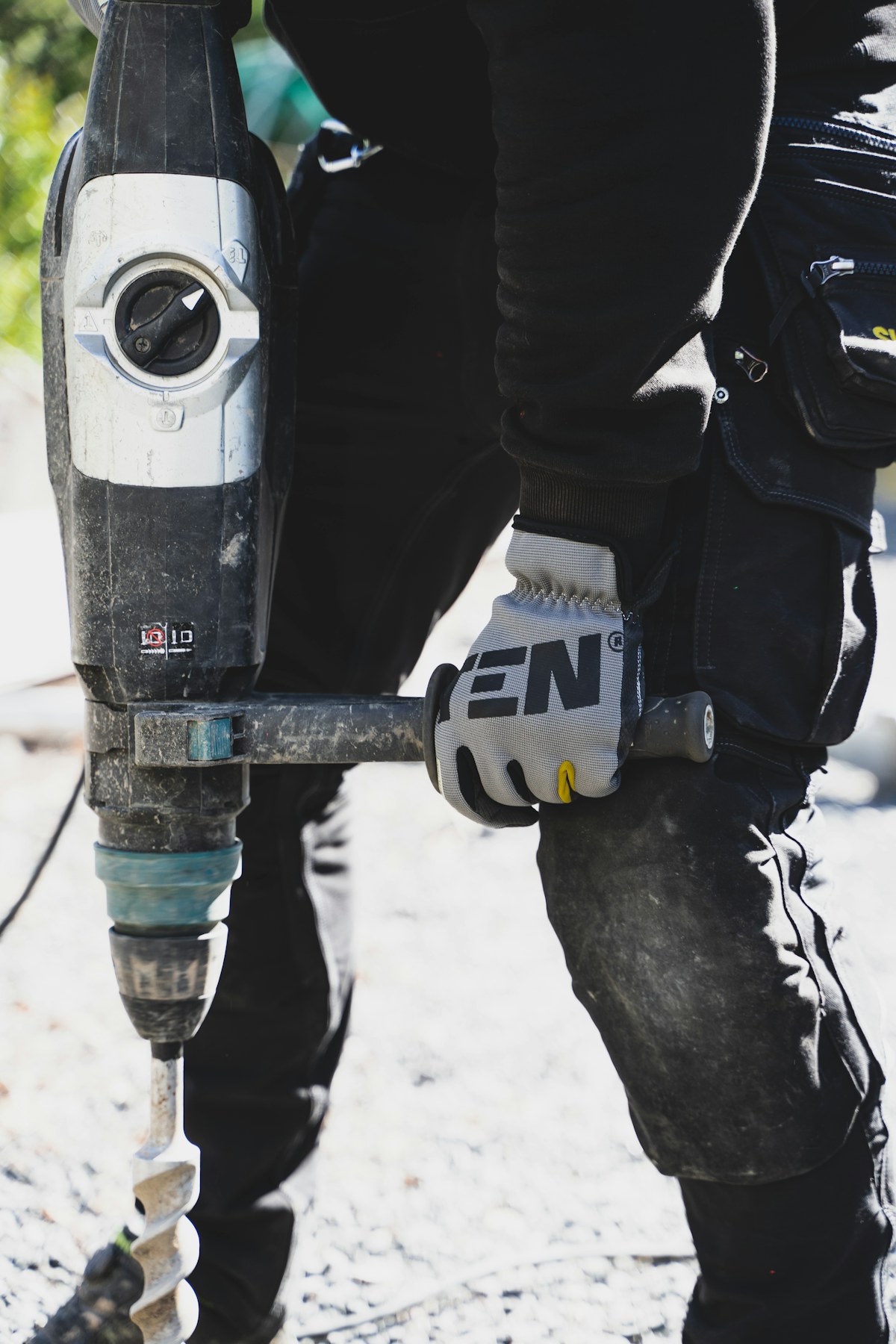
Hand-arm vibration syndrome (HAVS) is an irreversible occupational disease caused by regular exposure to vibrating tools and equipment. In UK construction, it affects an estimated 2 million workers, with over 17,000 suffering severe disablement. Diamond core drilling produces a fraction of the vibration of equivalent percussion drilling — a meaningful difference for operatives who drill regularly, and a requirement rather than a preference on work where structural disturbance or surface finish must be preserved.
This guide covers the disease, the legal framework, the vibration outputs of different drilling methods, and the practical steps to keep exposure below legal limits.
Low Vibration Drilling at a Glance
- Diamond core drilling: typically 2–5 m/s² — significantly lower than SDS hammer drilling (8–18 m/s²)
- EAV (Exposure Action Value): 2.5 m/s² A(8) — daily vibration dose at which employer action is required
- ELV (Exposure Limit Value): 5 m/s² A(8) — legal maximum daily vibration dose, must not be exceeded
- HAVS is irreversible — symptoms do not resolve after exposure ceases, only stabilise
- Health surveillance is required for workers regularly exposed above the EAV
What Is Hand-Arm Vibration Syndrome (HAVS)?
HAVS is an umbrella term for two distinct but often co-occurring conditions caused by repeated exposure to hand-transmitted vibration:
Vibration White Finger (VWF)
A vascular disorder in which the blood vessels in the fingers contract excessively in response to cold or stress, cutting off circulation. Fingers turn white (blanching), then blue (cyanosis), then red (recovery) as blood flow is cut off and then restored. In severe cases, blanching is triggered by any temperature change, lasts for extended periods, and causes intense pain. Gripping a tool becomes difficult and eventually impossible in affected fingers.
Carpal Tunnel Syndrome and Neurological Effects
Vibration also damages the sensory nerves in the hands and wrists. Symptoms include persistent tingling, numbness, and loss of fine grip and dexterity. Carpal tunnel syndrome — compression of the median nerve at the wrist — is strongly associated with regular vibration exposure and may require surgical intervention.
Both conditions are progressive. Early symptoms are mild and intermittent; continued exposure causes permanent, severe disability. HAVS is not reversed by stopping work — removing the worker from vibration-generating activities halts progression but does not restore lost nerve or vascular function.
What Are the UK Legal Limits for Vibration Exposure?
The Control of Vibration at Work Regulations 2005 set two daily vibration exposure values, expressed as A(8) — the vibration magnitude normalised to an eight-hour reference period:
- Exposure Action Value (EAV): 2.5 m/s² A(8) — at or above this level, the employer must take action: assess the risk, introduce controls, provide health surveillance, and inform and train workers.
- Exposure Limit Value (ELV): 5 m/s² A(8) — this is the legal maximum. Workers must not be exposed above this level. If an operative exceeds the ELV, work must stop until controls are implemented to bring exposure below it.
Daily exposure is calculated from the vibration magnitude of the tool (measured in m/s²) and the duration of use. A tool with a high vibration magnitude reaches the EAV quickly — sometimes within minutes. The HSE provides an online calculator and ready-reckoner tables for common construction tools.
Why Does Diamond Core Drilling Produce Less Vibration?
Percussion drilling — SDS Plus, SDS Max, or pneumatic breaking — works by delivering repeated mechanical impacts to the material. The energy of each impact is transmitted back through the tool body into the operator's hands. Impact frequency in SDS drilling ranges from 1,500 to 4,500 beats per minute. At the tool body, this produces vibration magnitudes of 8–18 m/s² in typical construction applications.
Diamond core drilling is rotation only — there is no percussion mechanism. The cutting action is continuous abrasion rather than impact fracture. The vibration transmitted to the operator comes only from motor imbalance and bit runout, not from the fundamental cutting mechanism. Diamond core drills typically produce 2–5 m/s² at the handle in normal operating conditions.
The practical consequence: at 5 m/s², an operative reaches the EAV (2.5 m/s² A(8)) in approximately 30 minutes of tool contact time. At 2.5 m/s² (typical diamond core drill), the same EAV threshold is reached after approximately two hours of contact time. For tradespeople who drill intermittently during a working day, this difference is the margin between compliant and non-compliant daily exposure.
Vibration Comparison: Drilling Methods
| Method | Typical Vibration (m/s²) | Time to EAV at 2.5 m/s² A(8) | Suitability for Structural Work |
|---|---|---|---|
| Diamond core drill (dedicated motor) | 2–5 m/s² | ~1.5–2 hours | Yes — primary method for concrete and reinforced concrete |
| SDS Plus with core adaptor | 8–12 m/s² | ~10–18 minutes | Limited — soft masonry only, small diameters |
| SDS Max with core adaptor | 10–18 m/s² | ~4–12 minutes | Not recommended above 65mm |
| SDS Plus — standard hammer drilling | 8–15 m/s² | ~6–18 minutes | Not applicable for core drilling |
| Pneumatic breaker / demolition hammer | 12–25 m/s² | ~2–8 minutes | Not applicable for precision drilling |
Vibration figures are indicative. Actual values depend on the specific machine, bit condition, material hardness, and operating technique. Use manufacturer HAV data for compliance calculations — HSE's ready-reckoner or the HAVS calculator at hse.gov.uk/vibration accepts manufacturer-stated vibration values.
When Are Low-Vibration Methods Required or Preferred?
Diamond core drilling is required rather than preferred in the following situations:
- Daily exposure compliance — where a worker's total daily vibration exposure from all tools already approaches the EAV, switching from an SDS hammer to a diamond core drill for coring tasks may be the only way to stay within the ELV for the day.
- Structural concrete — percussion methods are mechanically inadequate for dense or reinforced concrete above small diameters. The reinforced concrete drilling guide covers why dedicated core drill machines are required.
- Sensitive finishes and surfaces — percussion vibration propagates through wall and floor structures, cracking plaster, loosening existing tile adhesive, and disrupting decorative finishes beyond the immediate drill zone. Diamond core drilling confines disturbance to the cut circle.
- Post-tensioned or prestressed concrete — the shock loading from percussion drilling near post-tension anchor zones is inadvisable. Core drilling is standard practice.
- Near vibration-sensitive equipment or occupants — in occupied buildings, hospitals, laboratories, or data centres, percussion vibration is often unacceptable. Core drilling's lower vibration signature is the justification for premium contractor rates in these environments.
How to Reduce Vibration Exposure When Core Drilling
Even at the lower vibration levels of diamond core drilling, prolonged exposure accumulates. Practical steps to keep exposure below the EAV:
- Use the correct machine — a dedicated core drill motor with a balanced chuck and correctly specified bit produces less vibration than a high-power SDS motor running an adaptor. See the core drill machine guide for specification comparison.
- Maintain the bit — a worn, glazed, or unbalanced bit increases vibration at the handle. A bit that has lost a segment runs with significant imbalance. Inspect bits before use and replace rather than run a damaged bit.
- Use a machine stand for large-diameter work — for cores above 107mm, a stand-mounted motor transfers the machine's reaction forces to the stand rather than the operator's hands, reducing hand-transmitted vibration substantially.
- Rotation-only mode — confirm the hammer function is disabled. Any inadvertent percussion multiplies vibration output by a factor of 3–5×.
- Anti-vibration gloves — provide limited but measurable attenuation for the high-frequency components of vibration. Must be rated to EN ISO 10819. Note: gloves do not substitute for engineering controls and do not reduce low-frequency vibration effectively.
- Work rotation — where multiple operatives are available, rotating the core drilling task limits each individual's daily exposure dose.
Health Surveillance for Vibration-Exposed Workers
The Control of Vibration at Work Regulations 2005 require health surveillance for workers who are regularly exposed at or above the EAV. For construction operatives who core drill regularly, this means:
- Initial baseline assessment before or shortly after starting vibration-exposed work
- Periodic follow-up assessments — typically annual in the first few years, then at longer intervals if no symptoms develop
- Symptom reporting system — workers must have a route to report early HAVS symptoms (finger blanching, tingling, numbness) without fear of losing work
- Records retained for the working lifetime of the employee plus 40 years (consistent with COSHH health surveillance requirements)
A worker who develops early-stage HAVS symptoms must be removed from further vibration-generating work until assessed by an occupational health physician. Continuing to expose a worker with diagnosed HAVS is a RIDDOR-reportable condition and an HSE enforcement priority.
For the broader framework of occupational health obligations in construction — covering silica as well as vibration — see the silica dust control guide and the diamond core drill safety guide.