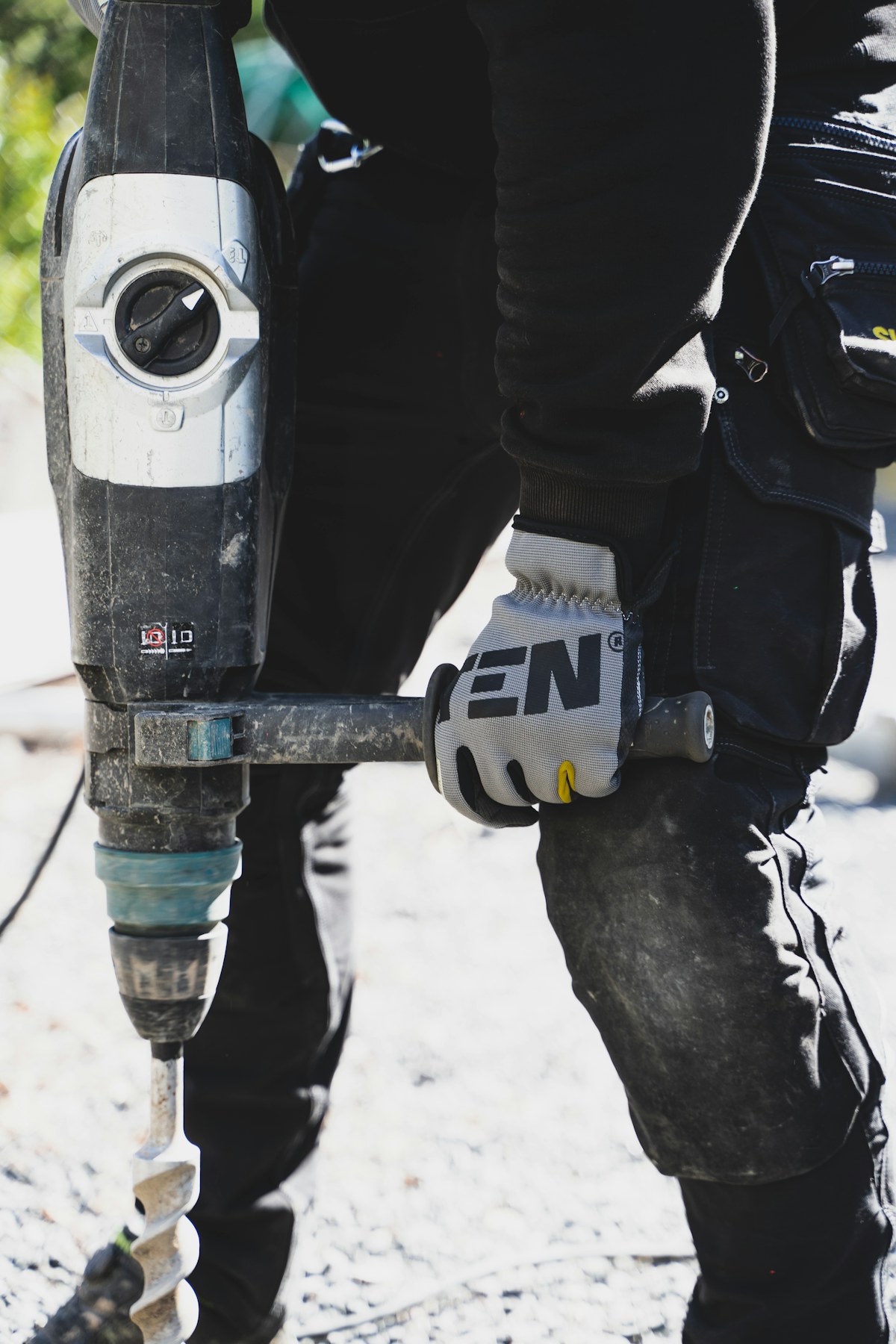
Diamond core drilling uses a defined set of equipment — each component serves a specific function in the cutting, cooling, and extraction process. Understanding which machine, bit type, and dust control equipment applies to a given material and hole size prevents equipment damage, ensures regulatory compliance, and produces a clean, correctly dimensioned hole. This page covers the main categories of equipment used in professional diamond core drilling in the UK.
Core Drilling Equipment at a Glance
- Core drill motor: dedicated rotary-only machine, 1,200–2,500W, ½" BSP water-feed chuck for wet drilling
- Diamond core bits: dry-rated (brick/masonry), wet-rated (concrete), universal — bond matrix matched to material hardness
- Motor-and-rig: required for precise alignment and for any hole above 107mm in concrete
- M-Class vacuum: EN 60335-2-69 rated, ≥99% filtration — legally required for dry masonry drilling under COSHH
- GPR scanner: mandatory before drilling structural concrete where post-tensioning cannot be confirmed absent
- Water supply: mains or pressurised tank, 0.5–1 litre/min minimum for wet coring
Core Drill Motors
A dedicated core drill motor is a rotary-only machine with no hammer function. It drives the diamond core bit at controlled, variable speed without the percussive action that would shatter the diamond segments and fracture the hole wall. Core drill motors for professional use share a common set of characteristics:
- Chuck connection: ½" BSP (British Standard Pipe) threaded connection or a compatible quick-release system. The BSP thread is the UK and European standard for core drilling equipment — it allows core bits to be threaded directly onto the machine spindle.
- Water feed: An internal water swivel on the chuck or spindle routes water from an external supply through the centre of the rotating core bit to the cutting face. This is required for all wet coring applications.
- Power rating: 1,200W to 2,500W for trade machines. 1,200–1,500W handles most domestic and light commercial work (up to 150mm in brick and concrete). 2,000–2,500W is required for large-diameter drilling in C35+ structural concrete.
- Variable speed: Most professional core drill motors have at least two speed ranges (high and low gear). Variable-speed electronic control within each range allows RPM to be matched to the bit diameter and material. Concrete requires lower RPM than brick at equivalent diameters.
For machine selection guidance: core drill machine buyer's guide. For SDS adaptor setups on standard SDS drills: SDS Plus vs SDS Max core drill guide.
Diamond Core Bits
The diamond core bit is the cutting tool — a hollow steel barrel with diamond-impregnated segments welded to the cutting end. Bit selection is the single most important variable in core drilling: the wrong bit on the wrong material destroys the bit and fails to cut effectively. Three variables determine the correct bit:
Dry vs Wet Rating
Dry-rated bits have a slotted or turbo barrel profile that allows air circulation to cool the segments. They are designed for brick, blockwork, and aerated concrete — materials that do not generate enough heat to require water cooling. Wet-rated bits have a solid barrel and use water supplied to the cutting face to manage segment temperature. They are required for concrete, reinforced concrete, and hard masonry. Never run a wet-rated bit without water — it destroys the segments within seconds. See: dry vs wet core drilling: complete guide.
Bond Matrix Hardness
The diamond segments are held in a metal bond matrix that wears progressively to expose fresh diamond crystals. Bond hardness must match material hardness in reverse: hard, abrasive materials require a soft bond (which wears quickly, constantly re-exposing diamond); soft, non-abrasive materials require a hard bond (which wears slowly and holds the diamond longer). Using a hard bond on concrete causes the bit to glaze; using a soft bond on brick causes rapid premature wear. See: diamond core drill bit maintenance guide.
Rebar Rating
Standard wet bits are not rated for cutting through steel reinforcement — the thermal and mechanical shock of cutting rebar can separate the segments from the barrel. Rebar-rated bits have reinforced segment-to-barrel attachment and a combined segment formulation designed to cut both concrete and steel without segment loss. Any coring through reinforced concrete requires a rebar-rated wet bit. See: reinforced concrete drilling guide.
Common UK Trade Sizes
| Diameter | Primary Application | Typical Bit Type |
|---|---|---|
| 38mm | Cable and conduit entries | Dry — hard bond |
| 52mm | 40mm waste pipe | Dry — hard bond |
| 82mm | 75mm duct, structural sample | Wet or dry depending on material |
| 107mm | Boiler flue, extractor fan (100mm) | Dry — hard bond for brick; wet for concrete |
| 117mm | 110mm soil stack | Dry — hard bond for brick |
| 133mm | 125mm MVHR, 80/125mm flue | Dry — hard bond for brick |
| 150–200mm | Large service penetrations, M&E risers | Wet — rebar-rated for concrete |
| 200–600mm | Plant access, large structural openings | Wet — rebar-rated, rig required |
Full size and material reference: diamond core drill bit sizes chart and diamond core drill bits guide.
Motor-and-Rig Systems
A motor-and-rig system couples the core drill motor to a rigid carriage that advances the bit along a feed column under controlled, steady load. The rig absorbs torque reaction that would otherwise be transmitted through the operator's hands and arms, and ensures the bit enters and tracks perpendicular to the drilling face. Rig types for different applications:
Wall-Mounted Rig
A track and carriage bolted directly to the concrete or masonry wall surface using anchor bolts or a vacuum suction base. The carriage traverses the track to feed the motor and bit into the wall. Required for precision-aligned holes in structural concrete above approximately 107mm diameter, and standard practice for any wet coring in commercial or industrial concrete. The rig converts operator-applied load into controlled, consistent feed pressure — critical for maintaining RPM and preventing bit stalling in dense material.
Floor Rig (Vacuum Base)
A stand with a vacuum base plate that suction-locks to the concrete floor surface. Provides a stable platform for vertical core drilling — floor penetrations for drainage, service entries, and anchor bolt holes. The vacuum base eliminates the need for anchor bolt installation in the floor, but requires a clean, dry floor surface for effective suction. A safety chain connecting the rig to a wall anchor is standard practice.
Column-Mounted Rig (Large Diameter)
For large-diameter coring (200–600mm), a column-mounted rig attached to a structural element adjacent to the drilling position provides the rigidity needed to absorb the torque and feed forces at these diameters. A handheld motor cannot be used above approximately 52mm in dense concrete due to uncontrollable torque reaction if the bit stalls. See: industrial core drilling services.
M-Class Dust Extraction
An M-Class (Medium hazard) vacuum extractor is the legally specified dust control for dry masonry drilling and chasing under COSHH 2002. M-Class vacuums meet EN 60335-2-69 with a filtration efficiency of ≥99% at 0.3 microns — the particle size range that includes respirable crystalline silica (RCS). Key equipment characteristics:
- Filtration standard: The filter must hold the M-Class certification — not all construction vacuums do. Check the machine label or specification sheet for EN 60335-2-69 Class M before purchase or hire.
- Dust shroud: A rubber or plastic shroud fits around the core bit or drill body and creates an enclosure at the cutting face that connects to the vacuum hose. The shroud must maintain contact with the wall surface to prevent dust bypass.
- Filter maintenance: A blocked filter reduces airflow and dust capture performance. Filters should be shaken or replaced regularly — most M-Class vacuums have a filter-cleaning mechanism. Bag and filter changes must be done with respiratory precautions.
For wet drilling, primary silica suppression is achieved by the water — but residual mist and slurry handling still requires care. Where wet drilling generates significant mist (e.g., overhead work), supplementary respiratory protection is advisable. See: core drill dust extraction guide and health and safety in diamond core drilling.
Water Supply Equipment
Wet core drilling requires a continuous low-pressure water supply to the cutting face. Supply options:
- Mains connection: A standard garden hose fitting connects the machine's water inlet to the building's mains supply via a pressure regulator. Flow rate required: approximately 0.5–1 litre/min for 50–150mm bits; more for larger diameters.
- Pressurised water tank: A portable 15–20 litre container pressurised with a hand pump or compressed air. Used where mains connection is impractical (outdoor work, remote locations, or where water cannot be connected before the job starts). Capacity typically sufficient for 2–3 standard commercial penetrations.
- Recirculating system: On long programmes, a pump recirculates filtered water from a collection sump. Used for large-diameter high-volume drilling where continuous water supply from a mains hose is impractical or where slurry must be contained and recycled.
GPR and Ferroscan Scanning Equipment
Pre-drill scanning is a safety-critical step before any structural concrete drilling. Two technologies are used:
- GPR (Ground Penetrating Radar): A hand-held or trolley-mounted antenna transmits radar pulses into the concrete and records reflections from internal features — rebar, PT ducts, conduits, and voids. GPR detects both conventional reinforcement and post-tensioned grouted tendons. Mandatory where PT cannot be confirmed absent by structural drawings.
- Ferroscan / cover meter: An electromagnetic induction tool that locates metallic reinforcement and measures cover depth. Faster than GPR for straightforward rebar mapping. Cannot reliably detect grouted PT tendons — use only where PT is confirmed absent.
GPR scanning is typically carried out by a specialist scanning contractor, not the drilling contractor. The scan report documents rebar positions, PT duct locations (where present), and safe drilling zones. See: GPR scanning before core drilling: UK guide.
Accessories
Supporting equipment used alongside the core drill motor and bit:
- Pilot drill (centre bit): A small drill bit fitted to the centre of the core bit that marks the hole centre and prevents the core bit from walking across the surface on startup. SDS or standard hex shank depending on the machine.
- Extension rods: Threaded extensions that increase the effective drilling depth beyond the standard barrel length. Used for deep masonry walls (300mm+ penetrations) and when the motor body cannot reach the full wall thickness.
- SDS adaptors: Convert a ½" BSP core bit to an SDS Plus or SDS Max chuck on a standard drill. Suitable for small diameters (up to approximately 50mm) in soft masonry only. See: SDS adaptor guide.
- Core ejector / slug removal tool: A rod or screwdriver used to push the masonry core slug out of the barrel after drilling. On dry bits, the slug remains in the barrel after completion.
- Dust shroud: Connects to the vacuum hose and creates an enclosed cutting zone. Available in sizes matching standard core bit diameters, with flexible skirts to conform to uneven surfaces.
Full accessories guide: diamond core drill accessories.